Top 75 Prospects In The 2026 NFL Draft (Post NFL Combine)
The NFL Combine is filled with buzz, some real and some just noise. Their interviews matter, their medicals matter, their size matters, and their testing matters. Just how much so depends on their position, the way they win, and a lot more. I took in all of the information to update what was my initial Top 40 prospects into today's Top 75 Overall Big Board. I'll post one more update when I have my Top 100 ready, and the player reports will eventually get longer after re-watching each player once more.
My rankings always adjust for positional value so my readers don't need to try to then re-rank the prospects themselves. While not exactly the point, think of this ranking as how much money they'd re-sign for on their second contracts. The open market is a great way to measure how valuable each player and position are. Here are the top 10 post-rookie contracts by position in terms of APY and Total Guarantees as a reference point:
QB: $54M/yr | $204M guaranteed (tier break)
EDGE: $36M/yr | $104M guaranteed
WR: $32M/yr | $82M guaranteed (tier break)
OT: $26M/yr | $72M guaranteed
DT: $25M/yr | $68M guaranteed
CB: $23M/yr | $70M guaranteed
OG: $21M/yr | $57M guaranteed (tier break)
S: $19M/yr | $40M guaranteed
LB: $15M/yr | $35M guaranteed
TE: $15M/yr | $31M guaranteed
RB: $14M/yr | $24M guaranteed
C: $11M/yr | $27M guaranteed
Last thing: Compete. This is a very fun ... yet serious project for me. They rank the Top 100 Big Boards every year, and I'm trying to repeat the best big board on the internet, something I held in that Justin Herbert and Justin Jefferson draft class. If we don't come in first again, I will be mad on the internet. We can't have that.
QB1 Fernando Mendoza, Indiana
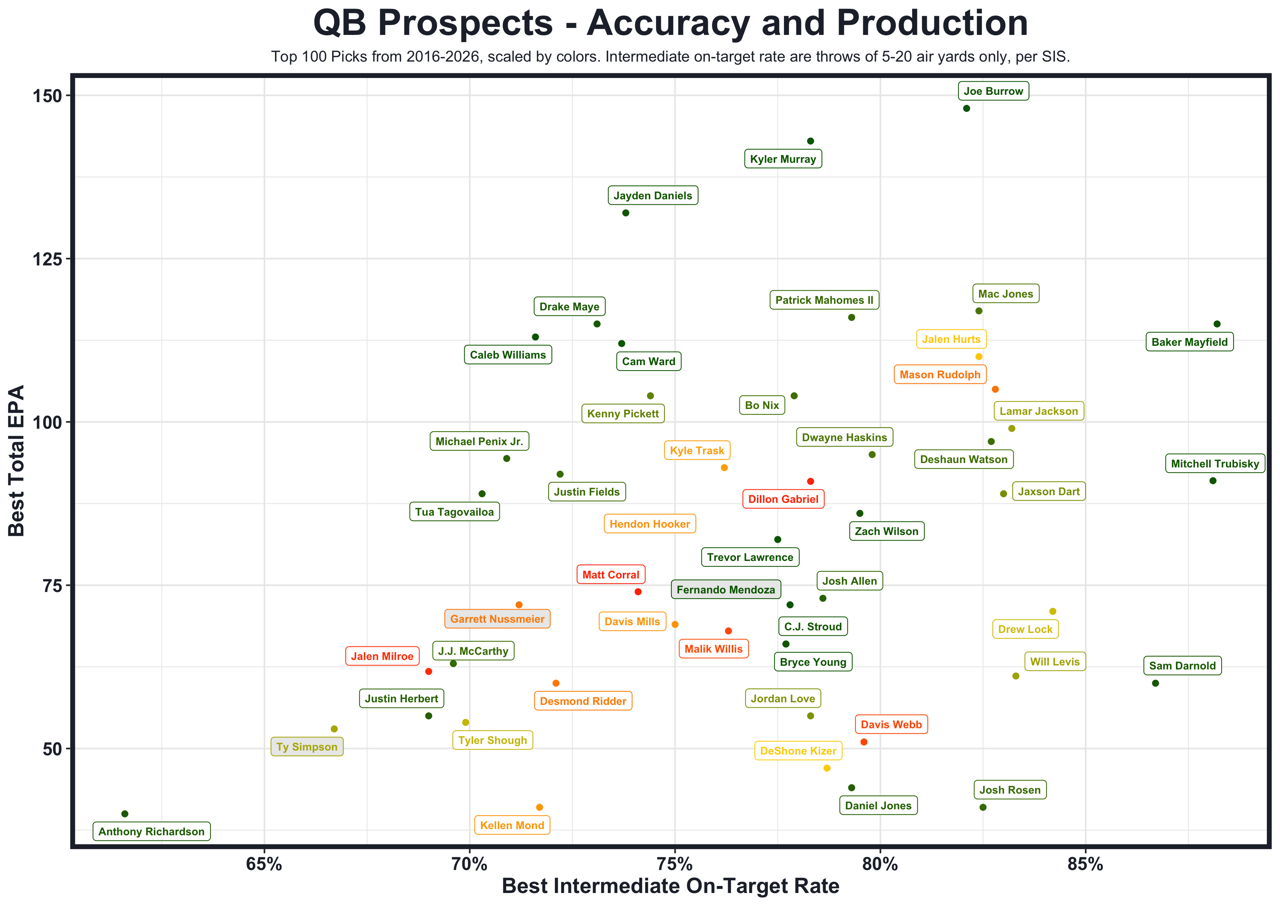
The 22-year-old early declare is a 6'4"/236 big-armed robot still in development. His QBR sits in the 92nd percentile among drafted QBs, and he did so without a loss against an 85th percentile strength of schedule. Mendoza very rarely puts the ball into harm's way, but he does hunt for the big throw and does so with great accuracy. His 78% on-target rate on intermediate throws (per SIS) is strong, and that's a predictive measure. His 68% on-target rate on sideline throws beyond 10 air yards is also strong, and he ripped in a bunch of downfield back-shoulders and on-time out routes to the far side of the field on tape. This deep shot is the best throw I've seen from him so far as an example. Indiana ran a healthy amount of RPOs and didn't have the full-field progressions built into the offense like he will in the pros, but don't let that be a distraction. Mendoza can make all the big-boy throws from within the pocket or in the rollout game.
His scramble ability is functional, and he can break tackles because of his size. Here's a fun one against UCLA, and then there was the famous one in the Natty. He ultimately posted 78th percentile rushing EPA among drafted QBs, enough for upside in the modern era. Mondoza is also very tough. He took big hits to develop deeper routes and just bounced up, which is why his teammates and coaches absolutely love him. Mendoza's growth from a 3-star recruit to the 1st overall pick stands out, too.
There are some uncertainties in the profile, however. Mendoza wasn't under center ever, something he'll have to get used to with HC Klint Kubiak. Sometimes there's a multi-year adjustment to re-scanning the field after turning the helmet away in the under-center play-action game, and that could be especially true for him. Most alarming to his overall profile is Mendoza didn't make nearly as many backside throws through progressions as the other 1st-overall prospects. It's not that he'd force 1st-read throws or throw the ball into a LB's grill on the backside, but instead of getting to the 2nd- or 3rd-read, he'd drop his eyes out of habit. He at least did eventually make some nice throws on the run, but his comfortability as a progression QB is unanswered. He certainly has the height to see the field and the seriousness for real development, so I'd project this to happen long term.
In the meantime, Mendoza will be extremely smart pre-snap, hit all the throws he does take, and rarely put the ball into harm's way. His physical skillset is similar to Trevor Lawrence (with fewer bad decisions). His demeanor is that of a 6'5"/236 version of Kirk Cousins (complimentary).
LB1 Arvell Reese, Ohio State
The 20-year-old early declare is a 6'4"/243 former 4-star recruit with split opinions on whether he's an edge rusher or off-ball linebacker for the majority of his snaps. PFF only had him with 12 outside pass rushes the entire year, even far off from tweener Jalon Walker (36) in last year's class for example. When given pure pass rushes, he doesn't have moves but simply wins often based on his rare athleticism. Ohio State, however, mostly used him as an off-ball linebacker who would line up as a 5th player on the line of scrimmage or as a blitzer, and that's exactly how I'd use him, too. He'd likely need to add some weight to be a full-time edge rusher, but why create a projection when he's a potential All Pro off-ball linebacker in his current state?
Reese diagnoses things quickly, has the speed (4.46 forty) to close space, and the length and strength to finish tackles. He can mirror RBs out in space and just never misses tackles. He also sets the edge with knockout power as good as any LB you'll see. TEs necks are consistently snapped off their shoulder pads, and that even happens against OTs, too. The hands? Well, they're heavy. As a blitzer, Reese has incredible chase-down speed and blows up RBs on contact. He recognizes screens, can play the QB as a spy at a great level, and will chase players down to the sideline. He should be an amazing player in pure pass coverage with more experience, but the 20-year-old was not an excellent hook/curl zone defender quite yet, nor called the plays on defense. Reese can do a lot of things, but being the middle linebacker green dot player is not it so far. That's okay because he's as unique as an off-ball linebacker as you'll find. His physicality is that of a Ray Lewis type, but he'll float near the line of scrimmage a lot more than Lewis types did in the 2000s and 2010s. Reese really fits what linebackers are tasked with in the 2020s. For that reason, it's hard to come up with a clear comparison.
LB2 Sonny Styles, Ohio State
The 21-year-old redshirt junior is a converted safety and former 5-star recruit who wore the green dot for Matt Patricia's Ohio State defense. He has great length (6'5"/244), a very athletic build, and the range to chase down checkdowns and scrambles at a level that most linebackers in this class can't touch. He had a great deflection at the goal line that showed off his coverage instincts in tight space, but it simply helps to be 6'5", which is 95th-percentile height for the position, with elite speed. As a blitzer, he murders RBs on contact and sheds blocks well, posting 6.0 sacks in 2024 with a high pressure rate throughout. Styles gets a little lost in zone coverage over the middle right now and is still very new to the position. Some RBs and TEs can leak out on him, and he had very few man coverage reps on tape, but there's no reason to believe he won't be extremely good tracking down RBs and TEs with more experience. He posted a 43.5" vertical, then a 99th percentile broad jump, then a 97th percentile weight-adjusted forty for crying out loud.
His 5.9 tackles per game is in the 24th percentile among drafted LBs, but LB Arvell Reese, S Caleb Downs, DT Kayden McDonald are largely to blame. The tools are ridiculous, so the production is coming. The things that are hard to measure, like moving through traffic in the run game and tackling technique, stand out. If he hits, there's a Luke Kuechley baseline of traits in Styles, and he should hit the ground running coming from a pro-styled defense. It won't be that surprising if he's viewed as the best traditional off-ball linebacker in the NFL in very short order. His interviews have been awesome per all reports.
WR1 Carnell Tate, Ohio State
The early declare is a 6'3"/195 pure outside receiver and former 5-star recruit from the IMG Academy, who put up 79.5 receiving yards per game as a junior in his lone season as a starter. He dunks on DBs at the catch point, posting 3.1 yards per man route removing screens. Against zone, he was equally dominant at 3.2 yards per zone route removing screens with scramble drill grabs and toe drags on the sideline. He eats up space versus off coverage with solid downfield speed (4.53 forty) and can create separation deep after threatening to beat them horizontally. His overall route running cleanliness paired with the catch point skills are the calling cards. There's some underneath work, too, but he's not a tackle breaker or particularly shifty in tight spaces. As a bonus, he fights as a run blocker. In fact, Ohio State lined him up close to the TE on run plays by design to block LBs on edge runs, which tells you something about his toughness. Tate may not be a 150+ target receiver, but he profiles as a team's top receiver who can do most things to a high level. ... Upside comp: Consistent George Pickens.
EDGE1 Rueben Bain Jr., Miami
The 21-year-old early declare is a dumb thiccc edge rusher at 6'2"/263 who was mostly a high-side rusher from an off-tackle four-point stance. The former 4-star can be moved around the front and kicked inside on some passing downs. His adjusted production sits in the 85th percentile among drafted EDGEs since 2005, and this past year, Bain easily led Power 4 edge rushers with 75 QB hurries (the next closest was down at 51!!!), while posting the 2nd-best win rate (24%). He did so next to another potential 1st-round pick against a difficult schedule.
To the surprise of many tackles, Bain has more bend than most of his size. He turns the corner and uses his extremely strong core and legs to stay on his path to the quarterback. That led to an absurd 38% win rate on outside moves, despite having bottom 1st percentile arm length (31"). He doesn't have a pass-rush plan reliant on long arms. He has a consistent, nice first step and threatens OTs with power or with hand usage to open up the outside shoulder. Bain most-often wins with a cross chop, ghost, rip, or swipe, none of which require long arms. He also does a good job of not being squared with OTs to expose his reach disadvantage. At the top of the arc, Bain has real bend, is too powerful to knock off his spot, and is often keeping low pad level to maintain leverage. It's what separates him. Bain only used a bull rush on 6% of his reps, and those are often after initially setting up an outside move first. There are wins where his power comes into play, but he's not bull-rush reliant.
His inside counter moves are mostly a huge club (like a boxer throwing a right hook) or a swim move with a little euro step action, once again neither of which are long-arm reliant. His other inside moves aren't polished or explosive, which is why so many of his reps end up in a brawl. Essentially, he's far more likely to finish with effort than be hitting a spin move. There were other times where his awareness of where the QB was resetting to allowed him to create pressure late into the dropback. All in all, Bain can have 10+ sack seasons with this profile, even if he's not going to lead the league in sacks.
Bain is physical enough and plays with enough leverage to play on run downs, even if his short arms will create some issues. He may not finish some plays or set the edge to the same degree that a longer defender would, but Bain did eat up snaps at Miami and finished with 15.5 TFLs. His energy, physicality, and leadership make him a great teammate. Comp: Normal-Biceped James Harrison, Melvin Ingram.
OT1 Spencer Fano, Utah
The 21-year-old early declare is a 6'5"/311 right tackle and former 4-star recruit. Fano has below-average size (37th percentile weight with bottom 2nd percentile arms) but is a great athlete, who tested in the 95th percentile in the forty and 81st percentile in the jumps at the NFL combine. On tape, Fano was beat on the outside maybe 2-3 times his entire career, and his 1.2% loss rate on outside moves in 2025 backs that up. He's extremely agile with great quickness and fires out of his stance, sticking with outside moves until they are guided beyond the pocket. He's a good-enough athlete to recover but usually doesn't need to because he's so balanced. His hand timing can get a bit better in pass protection, though. David Bailey got him on two spin moves, but that Texas Tech outing was his worst game by far. In general, he's clean and projects well in protection.
His nimbleness also means he's an asset in the screen game and as a run blocker, particularly in a zone scheme. He climbs to the next level with ease and has some nasty to him while hunting linebackers. There's a pound-for-pound strength that comes with him on man-based runs, and Utah ran the ball far more than they passed it. The Utes often ran it right behind him for a reason. There are some times where he can get a little upright or get knocked off balance when not expecting contact because he's so light in the shorts, but Fano doesn't have a gut and can add some weight in the pros; Fano already did from college to the NFL Combine. There's no reason to believe he couldn't play left tackle if asked to switch either. To reach his ceiling, he simply needs to get denser, as many pro rushers will opt to run through or inside him, rather than try to beat him around the edge with his quick feet. ... Combine comp: Shorter Rashawn Slater.
WR2 Makai Lemon, USC
The early declare is a 5'11"/190 mostly slot receiver and former 4-star recruit (50th overall at 247) with some clear wins as an outside player (TD vs. UCLA). He's stout and physical in the mold of Amon-Ra St. Brown. He stays on-route against man coverage with balance, a strong core, and hand fighting, and he has push off or a seal off at the catch point on fade routes. His 3.5 yards per zone route removing screens is the best in the class by far. He navigates zone coverage at an elite level, is great in the scramble drill, and toys with off-coverage quarters safeties. He can track the ball off his original route path with diving grabs and takes big hits over the middle. He had nearly 0 drops all year. That's where the Jaxon Smith-Njigba comps come to play, though JSN's long speed and stride length is a tick above Lemon's. His tackle breaking ability is real and shows itself in the screen game. Overall, Lemon fits the modern NFL as a threat for the most receptions if he goes to the right team. While he'll play in the slot in 3-WR sets, he did enough to stay in 2-WR sets, too. Reports out of the Combine about his interviews were negative, with The Athletic's Dane Brugler noting Lemon told teams he was the most competitive player in the draft before opting out of the Combine testing. ... Upside comp: Amon-Ra St. Brown.
OG1 Francis Mauigoa, Miami
The 20-year-old early declare is a 5-star recruit from the IMG Academy (6th overall per 247, next to Kadyn Proctor) who played right tackle but might be moving to guard long term because of his foot quickness. I'd still try him at right tackle at first for positional value after the season he had, though. "Sisi" posted a 1.6% pressure rate in 2025 with 0 sacks allowed. He's very powerful with a good, square build (6'5"/329 with 33.25" arms) and is rarely beat on a bull rush or with power. He's a walking anchor. His 4.8% loss rate versus outside moves and 12.1% loss rate versus inside moves are not elite, however. He doesn't have great recovery quickness and can over-reach at times, leaving him exposed to counters. He also doesn't cover a ton of ground out of his stance, so he may need some help against the higher-end speed rushers. These won't be serious problems at guard whatsoever!
His power is extremely obvious in the ground game. He's a monster 1-on-1 and can drive DEs off the line when he's not lunging too much. He does get to the next level with straight-line athleticism and attitude, even if he's not as nimble laterally. Mauigoa is a high-floor prospect with projectable traits best suited for guard. As a bonus, he can fire dance.
EDGE2 David Bailey, Texas Tech
The 22-year-old senior is a 6'3.5"/251 edge rusher who had 3 quality years at Stanford before a true breakout campaign at Texas Tech. Bailey had 19.5 tackles for loss, 14.5 sacks, and led Power 4 edge rushers with a 24% pressure rate and 25 QB hits. Bailey is a 4-3, speed rusher who beats tackles off the edge from a two-point stance. At the NFL Combine, he had a 93rd percentile weight-adjusted forty time, a 96th percentile broad jump, and a 67th percentile vertical. He posted an elite 25% pressure rate on 184 wide rushes (speed based) versus a 15% win rate on 122 3-4 front rushes (size based). His get off speed stands out instantly. Bailey's counter move is mostly a spin move. He can handle TE chips and win late into the dropback with quality chase-down ability, too.
He occasionally can win with a bull rush or long arm (67th percentile arm length), but he does not win with power or length often, and I don't think he will in the NFL. His weight was in the 22nd percentile. The schedule was fairly weak, so his forgettable 13.7% pressure rate against Utah, Arizona State, and Oregon is a concern. He did beat top-10 hopeful RT Spencer Fano with a couple of spin moves, however. Only 3.7 tackles per game puts him below average among drafted EDGEs, and against the run, he doesn't handle double teams well. It's a relative weakness, so he may get subbed out for some obvious run downs in the NFL. The good news is he's pound-for-pound strong. He bench pressed 405 pounds, squatted 550, and hit 22.16 mph per the Freak's List. If there's a weakness athletically, it's with his side-to-side lateral ability. It pops up on tape at times and then was more evident in the NFL Combine drills. ... Upside comp: Nik Bonitto.
S1 Caleb Downs, Ohio State
The early declare is a 6'0"/205 strong safety or nickel hybrid who was a 5-star recruit (8th overall at 247) and spent a year at Alabama before two years at Ohio State. He has the versatility to be a very modern NFL "position-less" player, capable of thriving in any scheme and over-the-middle position. His 1-on-1 coverage skills are fantastic. He will be a TE eraser in the NFL, but can also stick with slot receivers because he can flip his hips and tracks the seam well. He can play the deep post -- there was huge hit vs. Miami and then a great deflection leading to a teammate INT vs. Purdue -- but it's not his best spot and doesn't maximize his rare traits. Those are found near the box.
In run support, he's a great open-field tackler who can drive through a WR/TE block on a screen. He has great eyes and flies to the ball, all while being disciplined. There's a reason he posted 107 tackles as an Alabama freshman, then nearly matched it while playing next to multiple potential top-10 picks on that defense. Downs isn't Derwin James in terms of total athleticism, nor has Kyle Hamilton's size, but he should be as effective as they are in the pros. There's a great clip of Fernando Mendoza breaking down his tape out (here) if you want to nerd out on it.
For what it's worth, there's an unconfirmed report that Downs has knee troubles.
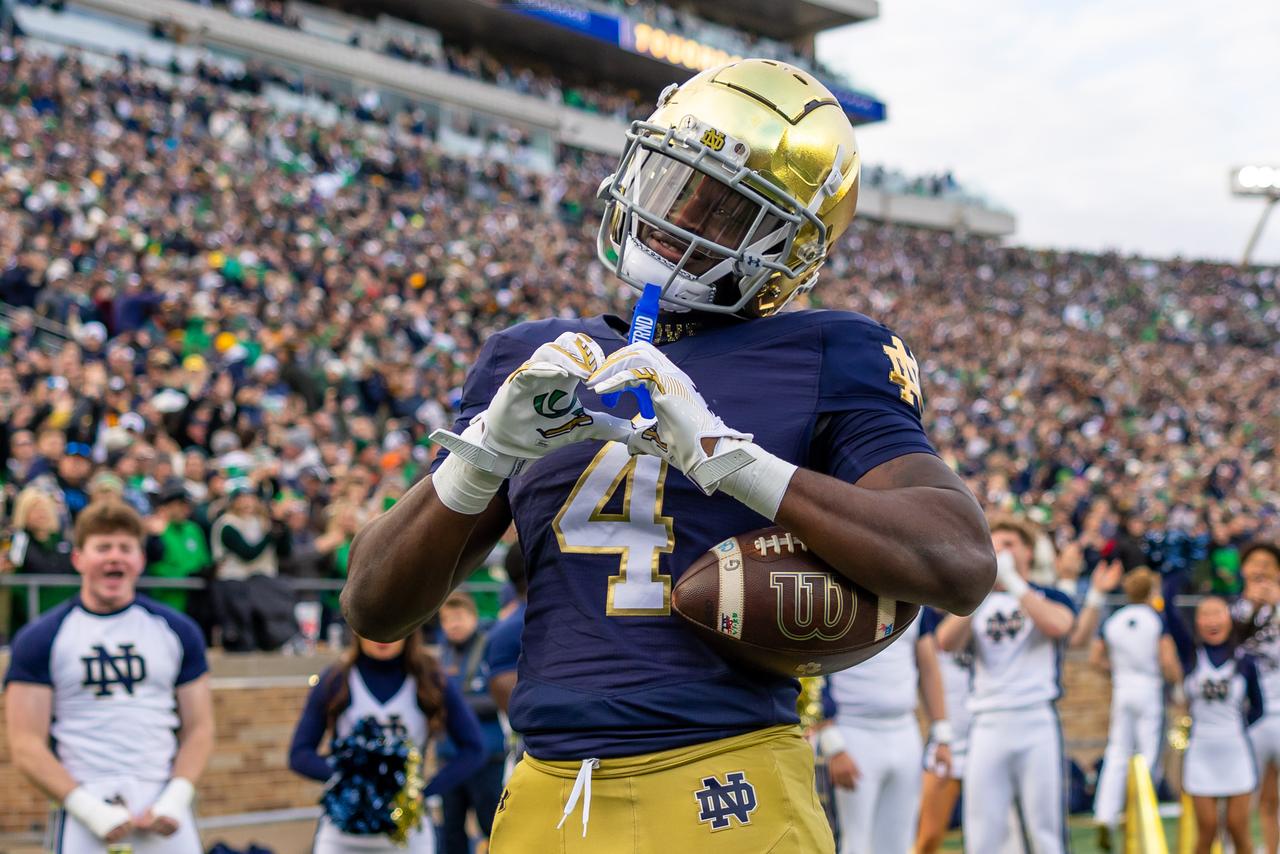
RB1 Jeremiyah Love, Notre Dame
The 20-year-old early declare is a 6'0"/214 back and former 4-star recruit (top-100 overall at 247) who split reps on great Notre Dame teams and still put up absurd numbers. His adjusted production sits in the 97th percentile according to my model, with an 87th percentile PPR points per game and a career 6.7 YPC. He has incredible speed on cutbacks, pressing outside zone to create backside angles and splitting safeties for explosive runs. He will bounce runs, but he gets away with it because of his short-area burst. In the open field, his change of direction is fantastic. There's an insane spin move against a LB that I keep going back to.
As a receiver, Love snagged a one-handed TD on a wheel route and was separately motioned around to find matchups, like on a slot corner route against an Arkansas LB. He ran angle routes and made defenders miss on swing routes. Love is also a quality pass protector with reliable scanning for blitzers. He even feels when OTs need help and has the size and toughness to square up rushers on his own. This is an easy bellcow evaluation. He's a better all-around prospect than Ashton Jeanty, even though they're polar opposites. ... Upside comps: Jahmyr Gibbs, DeMarco Murray.
OG2 Olaivavega Ioane, Penn State
The redshirt junior is a 3-year starter at left guard for Penn State and former 3-star recruit. He has a great base (6'4"/320 with 32.75" arms), is very physical, and simply doesn't get beat with power. His 0.7% pressure rate allowed is absurd, and the ones he allowed were on stunts or while pulling upon watch. He straight up didn't lose in pass protection the entire year. He's not an elite athlete, but he's functional enough to do everything asked of him, including working in the screen game. The Nittany Lions also placed him as a lead blocker at FB or TE as a bit. He'd annihilate dudes. While he doesn't have top-end recovery agility, Ioane rarely needed to use them. His interviews have been great from what I've watched.
OT2 Monroe Freeling, Georgia
The early declare is a 6'7"/315 left tackle and former 4-star recruit (No. 33 overall at 247) with just 16 career starts as a 1.5-year starter. He looks the part. He's lengthy and has the frame to even add some weight long term. In pass protection, he's aggressive in his set and meets contact early. Very rarely are DEs building speed to power against him. More importantly, Freeling has the athleticism to stick with speed rushers on the outside, re-set his feet against counters, and the strength to anchor. There are times when he can drift and over extend, but his recovery ability is really good. At the NFL Combine, Freeling had 34.75" arms, a 91st percentile forty, and 93rd percentile jumps. That's what the Pro Bowl tackles look like!
His 5.8% loss rate on outside rushes is higher than you'd like, but he was under 3% from Week 8 on, and that late-season tape was nearly flawless in 1-on-1 protection. The main pass-protection issues right now are largely mental, with too many errors on stunts and sorting out rushers pre-snap. In the run game, being so tall zaps some of his power as a down blocker when he over extends, but he's still a monster in terms of overall size and length. He meets linebackers well after double teams and in the screen game, and he would be able to handle a zone scheme, too. More reps would allow his processing to catch up with the physical tools. Stay patient.
OT3 Kadyn Proctor, Alabama
The 20-year-old early declare is a 5-star recruit (5th overall per 247) listed at 6'7"/352 with long-enough 33.5" arms and absurd strength. He squatted 815 pounds, benched 535, and power cleaned 405 per the Freak's List. His 32.5" vert at his size is outrageous!!! Alabama used him as a lead blocker, ran wild cat through him, and even threw him some passes. He has explosive hands and power when actually blocking. Players routinely get launched off of him, and he hops out of his stance well and drops his hips with real explosiveness. That was when he was playing at a much bigger weight than he is now.
The problem is he admitted to ballooning up to 400+ pounds early in his career, and the history with that type of profile has been terrible, which is why his 352-pound weigh in was such a big deal. The excess weight was where the lateral quickness stalled out in college. It was much harder for him to recover once he was beat, and that would push him to guard if the problems continued. His 19.5% loss rate on inside moves was very worrisome, and his 6.1% loss rate on outside moves is also below average. He was surprisingly bull rushed a handful of times due to late hands, so there is some development required here. He was pretty passive in his pass protection plan and could benefit by playing more aggressive, now that he is back at the weight were his recovery should pick up again. There's a world where Proctor is a Pro Bowl left tackle, despite the really up-and-down nature of his college career after infinite hype.
EDGE3 Akheem Mesidor, Miami
The 6th-year player is going to be a 25-year-old rookie, but there's context here. The former 3-star recruit came in as a 195-pound OLB from Canada and has developed into a good athlete with size (6'3"/259 with 32.2" arms) and a motor. He posted a fantastic 21% win rate on all pass rushes with 12.5 sacks and 17.5 TFLs, while lining up at a variety of spots. Mesidor is mostly line up off-tackle from a three-point stance, but his rushes up the B-gap were encouraging as he may move inside on obvious passing downs in the NFL. This all assumes that the rumors about his foot injury coming out of the NFL Combine aren't too bad to play.
Mesidor has great hand usage, violence, and pass-rushing repertoire. His first step is well-timed and explosive, and he keeps the opposition on their toes by changing his pacing as a rusher with more stutters, hesitations, and quick angles than many of his size. He does not use the same move over and over again, though his ghosts, dips, and rips were his top-performing moves. He doesn't have exceptional bend at the top of the arc, but it's good enough to be an NFL starter. When he's fully stopped and has to re-accelerate is when his athleticism looks better. Where he closes the gap is in his effort, power, and awareness. He creates a lot of production by staying engaged well after the initial plan, and he can anticipate where the QB is resetting to. None of that is a surprise if you've listened to Mesidor's awesome interviews. Some of those finishes from the college game will be harder to replicate because his average length and athleticism could get him swallowed up by NFL OTs.
His primary counter moves are a swim move and a bull rush pointed to the inside shoulder. His lateral ability to set up a swim move is wicked for his size and that trait could make him a candidate to pick-up work as an interior rusher or stunter. He can generate speed to power and has the ability to contort his body to win on the inside shoulder, even if he's not long-arming linemen. That said, Mesidor only went with a strict bull rush 3% of the time per PFF.
The run defense will come with highs and lows. His aggressive style and get off will create some highlights and led to 17.5 TFLs and 4 forced fumbles. He plays with good leverage and awareness, so he'll be reliable in the run fit, especially if the DC is encouraging shooting gaps on occasion. He is not going to set the edge with ideal length, but the effort and general power are there. He is not overly dynamic in the chase down department and missed plenty of near tackles, something I don't think is correctable given his age and measurables. In general, Mesidor is a ready-made starter if his medicals are cleared by doctors.
WR3 KC Concepcion, Texas A&M
The junior is a 5'11"/196, speed-based receiver who can work downfield or in the manufactured-touch game as a hybrid outside receiver (66% of his snaps outside). He put up 89 total yards per game as a freshman at NC State before transferring, posting a high of 70.7 receiving yards per game at Texas A&M (and that's with their bad QB play). He can shed some tackles with the ball in his hands, and his speed on run-away routes is staggering. He blew by Brandon Cisse in man coverage for an explosive, and then looked way faster than Mansoor Delane in their handful of reps. Both are Round 1 prospects.
He's elusive the moment the ball is in his hands, and that electricity is felt very early in the route. There's not a route he can't handle, and he doesn't have to oversell things either. He just gets open and will even finish with toughness. On the flip side, drops were an issue (I counted about 7 of them), and he ran out of bounds when wide open in the end zone. The drops were equally as concentration-based as clapping-based. This is not an alligator arm issue at all. Concepcion should contribute on special teams (see: elite punt returns against LSU) and has the route running plus athleticism to be a No. 1 target for an offense. ... Upside comp: Stefon Diggs.
S2 Dillon Thieneman, Oregon
The early declare is a 3-star recruit who spent 2 years at Purdue (100-plus tackles each year) before a 96-tackle season at Oregon. He's versatile, spending more snaps in the box as a deep safety at Oregon after being a deep safety at Purdue. His production is impressive; 90th percentile tackles per game among drafted safeties. He navigates through traffic and has the speed (4.35 forty and 41" vert) to run down the alley. He's not an overwhelming size-based player (6'0"/201), so he will miss some tackles that the true elites would make, but he's a very quality tackler in general. Thieneman gets to tackle attempts that he has no business getting to, so always keep that in mind if he misses a couple.
In coverage, the traits are tantalizing. At Purdue, he made elite INTs and pass deflections near the sideline from the post, where his speed stands out. He recognized his teammates' mistakes as a deep safety, then had a great feel for route concepts when rotating down. If needed to play in man coverage against a TE, Thieneman should thrive, even if the tape was a bit up-and-down there. He was beaten by Indiana for a TD in man coverage but had a great man-coverage rep against a James Madison slot. He got beat deep a couple times in the deep half at Oregon after having to shift his hips but had those great INTs as a single high at Purdue when working in a straight line. He made a lot of instinctual plays in zone coverage and is strong enough to fight at the catch point. Thieneman is a high-floor, high-upside safety who will rack up tackles and be in the right spot more often than not. He's likely to be a Pro Bowler. ... Upside comp: Eric Berry.
DT1 Caleb Banks, Florida
The redshirt senior is a 6'6"/327 defensive tackle with 35-inch arms who looks like many of the best interior defensive linemen in the NFL. Banks suffered a broken foot in September of his senior season and carried his weight worse in 2025 than in 2024, likely due to the injury. His 2024 tape is the real evaluation. He had an 11.6% pass rush win rate that year, which was very strong, along with 7.0 TFLs and 4.5 sacks. His game against LSU was that of a top-10 overall pick, winning in multiple ways from different alignments. He's a 3-technique who can move around the line with good pursuit for a massive DT. He's not as explosive as the All Pro DL talent, but the tools are strong (76th percentile vertical and 78th percentile weight-adjusted vertical).
His run-game numbers are middling, with his 0.83 solo tackles per game sitting in the 7th percentile among drafted DTs, but that Florida DL had a lot of talent for what it's worth. If the medical checks out and he can get back to his 2024 playing weight, Banks has the body type and pass-rush ability to be a long-term plus starter. It's unfortunate that Banks had to tap out of the end of NFL Combine testing due to his cleats hurting. That sums up a very inconsistent profile for the high-upside pass rusher.
CB1 Mansoor Delane, LSU
The 22-year-old senior is a 6'0"/187 outside corner and former 4-star recruit who spent 3 years at Virginia Tech before a full breakout at LSU. He allowed 0 touchdowns and 0 penalties all season!!! Delane is always in control; smooth, can change direction, and closes with a lot of fight at the catch point. He racked up 11 pass deflections because he plays the ball as well as anyone in this class, but his bottom 8th percentile arm length could make that a skill that's hard to fully translate against NFL receivers. Delane's best reps come in man coverage, where he gets into the chest of receivers despite not having bully size. He has good zone eyes, too, but his ability to mirror and stay connected in man is what separates him. There's a calmness to his game (complementary). His two minor concerns are his lack of elite downfield speed (watch him vs. KC Concepcion for example) and his work against the run where he's just okay there because he doesn't break down to make tackles well in space. That said, Delane profiles as a mid-range CB1 who can be trusted on the outside in any scheme because of his discipline and ball skills.
CB2 Colton Hood, Tennessee
The redshirt-sophomore early declare is a 3-star recruit who has played one year each at Auburn, Colorado, and Tennessee. He checks every box: size (6'0"/193), speed (4.44 forty with a 40.5" vert), tape, age. His best coverage reps come in man coverage, where he's physical and stays on the hip of receivers. He's a bit handsy at times, but that generally works in his favor. He makes plenty of plays on the ball or forces things out at the catch point. His off-coverage reaction time needs to get better, which could limit him early as teams test him with quick-breaking routes. He's a very capable tackler, however. He blew up a screen blocker and made an open-field tackle against Oklahoma for example. Hood switched sides as a primary outside corner and could be used as a shadow option if his upside hits. He was 1-of-14 Power 4 players to reach 23.0 MPH per PFF.
CB3 Jermod McCoy, Tennessee
The outside corner missed the 2025 season after tearing his ACL in January offseason workouts. When healthy, his stop, turn, and explode movement skills look fantastic. He has a thicker build that makes him hard to work through when the ball is in the air. There was a great end zone INT on a back shoulder against Alabama for example. McCoy is a very aggressive press-man corner, primarily lining up on the left side without switching sides or moving into the slot often.
That aggression is a double-edged sword, though. He did get beat quickly off the line against top competition. Aside from that interception, the Alabama outing was tough: slant for a first down, dragged beyond the sticks on a screen, a DPI, and multiple press losses. The matchup against Jeremiah Smith in the Ohio State game was rough, too. There was an off-coverage Cover 3 INT against UTEP, but the same rep is a touchdown against Kentucky. He didn't fight to make run-game tackles much, though he's physically capable (6'1"/188) when he turns up. The ACL is the obvious wildcard. If the medical checks out and he can get back to his pre-injury movement, McCoy has the press-man tools to be a No. 1 CB on the outside.
OT4 Blake Miller, Clemson
The senior is a maxed-out right tackle who broke the Clemson record for career snaps from scrimmage, playing 3,778 offensive snaps over 54 career games (all starts). He has a solid build, is long (34.25" arms), and isn't heavy in the midsection at 6'7"/317. He's a good athlete who isn't explosive out of his stance (5.04 forty) but can cover ground against a wide 9. His recovery quickness is average, as he plays fairly upright and tall. His 5.7% loss rate on outside rushes is solid but, once again, not elite. He finishes with a lot of energy in the ground game and can play in either scheme. Miller isn't going to wow anyone with traits, but there's real value in his experience and overall well-rounded skillset. The 32 bench press reps was a nice bonus.
TE1 Kenyon Sadiq, Oregon
The 21-year-old early declare is a former 4-star recruit and 2-year contributor who split time with other pros at Oregon. He came to Oregon at 220 pounds but is now 241. He's definitely explosive in a straight line with a muscular build that allowed him to jump 43.5" in the vertical and run 4.39 in the forty, both near record breaking.. In the route, Sadiq looks like a jumbo slot WR with multiple impressive seam wins for explosives. The USC game was his showcase: hurdle in the flats, high-point TD up the seam, and a runaway route TD. He had impressive catches on slightly off-target throws throughout the year, but he also dropped too many passes, a couple of them while working through contact. His 1.53 yards per route in 2025 is mediocre, down from 1.97 as a sophomore and far from the likes of Colston Loveland (2.7) and Tyler Warren (2.7). A lot of his production came on busted wheel routes or in other schemed-up ways, and there wasn't that much production working in zones. His spatial awareness is unproven, though he crushed his interviews per sources. He's surprisingly just fine after the catch and is a lot better in a straight line rather than moving around laterally or hitting the breaks, which did hurt some of his route running ability.
In the ground game, Sadiq offers plus blocking skills for his size, especially at the second level. He has nasty to him and finishes guys to the ground or sideline. He can battle against much bigger DEs because he's pound-for-pound strong, but there's very real physics concerns based on his total weight. He had some balance issues, but in general, he's a better blocker than expected for his listed size. His receiving ability requires some projection, but Sadiq is a great linear athlete who can be a full-time player (with some give and take) and No. 2/3 target in the pass game. Field Yates notes he led Oregon in special teams snaps in 2024, too. Dog. ... Comp: Smaller Vernon Davis.
CB4 Avieon Terrell, Clemson
The early declare is a 5'11"/186 corner, a former 3-star recruit with 2.5 years as a starter at Clemson, and A.J. Terrell's younger brother. He allowed a jump ball TD against LSU and doesn't have the size to be elite on the outside, but his movements are very fluid. He can mirror in coverage, can break on the ball in off coverage, and showed a lot of pound-for-pound toughness. Terrell does not have the elite explosiveness in his game, however, as seen by a 34" vertical and skipping the forty. There are size issues in projecting his run defense, but Terrell is willing to give it a go. He might need to be a nickel in the NFL, where his coverage skills can be maximized without asking him to win size matchups on the boundary, but his size isn't far off from the others in this class.
LB3 CJ Allen, Georgia
The 20-year-old is a former 4-star recruit out of Kirby Smart's program. He's a pre-snap leader who lines everyone up (see tweet below). On tape, he's a total animal. He has good straight-line explosion against runaway routes, good zone instincts, and can be an effective blitzer who will collapse a pocket at the very least. Allen is a thumper type at 6'1"/230. That's a pro and a con. He had 88 tackles, though his tackles per game sit in the 41st percentile among drafted LBs. The concerns are in his movement. He lacks a real change of direction, often diving for tackles instead of sliding his feet. He misses tackles on cutbacks in open space because of over-pursuit. Allen profiles as a starter who brings the physicality and leadership that coaches fall in love with, but his pass-game ceiling could be a bit capped.
WR4 Jordyn Tyson, Arizona State
The redshirt junior is a 6'2"/203 outside receiver and former 3-star recruit who had some maturity issues early on at Colorado before transferring out and finding his game at Arizona State, where he put up 92 and 80 yards per game against mediocre competition. He's a very smooth athlete with some explosiveness but isn't the elite straight-line athlete of the best receivers. Instead, Tyson can float in the air and makes diving grabs that look effortless. He lines up outside about 75% of the time, and his 3.0 yards per man route removing screens is strong. He's good out of breaks, can run the full route tree, and had a beautiful double move against TCU for a long TD.
He's a jestermaxxing route runner (aka there's sometimes too much flashiness in his route running), which could be a bigger deal against more physical NFL corners. He did make some extremely acrobatic grabs and generally has reliable hands, despite shorter 30" arms. His 2.4 yards per zone route removing screens is more pedestrian, and there were some physicality issues at times. He got shoved out of bounds on a fade, slid short on a 3rd-and-4 with 90 seconds left in a tied game, and didn't survive the ground or fight through contact in some contested situations. He's also missed a lot of time throughout his career, and his slender frame further raises durability questions. A near triple-ligament knee tear is a very big medical red flag, and could explain the follow-up hamstring issues. You have to respect his 26 bench press reps at least!!! Tyson has a wide range of outcomes but most likely slides in as a No. 2 receiver who is best when lined up at Z or in the slot. ... Comps: Slower Garrett Wilson, better hands Jerry Jeudy.
OT5 Caleb Lomu, Utah
The redshirt sophomore early declare is a linear left tackle who plays a bit upright (6'6"/313) but is a quality athlete, who tested with 87th percentile jumps at the NFL Combine. Aside from a few ankle rolls, Lomu moves around with ease at his current weight but could benefit from adding some density to improve his anchor. His hands were occasionally late, exposing his chest to power rushes. When he lost, it did look like Will Campbell's losses (derogatory). However, his length (33.4" arms) is rock solid and his timing can improve over time. In general, he doesn't overextend, stays patient, and plays in control, which led to a very good 4.3% loss rate on outside rushes. This gives him a starting-level traits in pass protection. In the ground game, Lomu doesn't drive DEs back because of his height vs. power, but he can climb to the second level when needed. His athleticism would stand out in a zone system and as an occasional puller.
EDGE5 Malachi Lawrence, UCF
WR5 Denzel Boston, Washington
The redshirt junior is a 6'4"/212 outside receiver and former 3-star recruit who lines up outside on 85% of the snaps, primarily as an X receiver. His first seasons were quiet due to elite competition around him, but he's come alive recently with 64 and 73 yards per game in his last two years. The intermediate game is where Boston will shine the most. He had two huge TD grabs against Washington State that showed what he's capable of at the catch point as a huge rebounder type in the red zone. He can make sliding grabs and toe taps near the sideline, and Washington even got him moving pre-snap to create some underneath moments where he broke some tackles with his size. He can run a lot of routes well because he can sink his hips for his size, which is why you'll see slant wins in his profile, too. His 2.6 yards per man route removing screens and 2.5 yards per zone route removing screens are solid and show how balanced of a prospect he is. In general, Boston profiles as a big-bodied No. 1 or No. 2 receiver who can win in contested situations and provide a large catch radius on layered zone throws. He does not have the top speed of the best in the X-receiver mold, which is why he ducked most of the Combine testing. Boston also dropped a couple of passes throughout the drills. ... Comps: Courtland Sutton, Jayden Higgins.
DT2 Kayden McDonald, Ohio State
The early declare is a very heavy nose tackle and former 4-star recruit who doesn't look sloppy despite his size (6'2"/326). He's an impact run defender who could be a top nose tackle in the NFL as a strict two-down player. He murders centers and guards in the run game with extreme power, violence, and great leverage. His 31 solo tackles put him in the 75th percentile among drafted DTs, and his 9.0 TFLs show he's finding the ball consistently. His 9% pressure rate is fine for a nose tackle type, but there's not going to be much upside there, as his pass rush ceiling is mostly walking a heads-up center back with a bull rush. He'll collapse pockets for teammate sacks, however. His lack of arm length (bottom 18th percentile) will work against him against better competition. McDonald is strictly a nose tackle, but he could be one of the very best in the NFL at stopping the run.
OT6 Max Iheanachor, Arizona State
The senior played right tackle in college, but he could play left if asked to based on his athleticism. Iheanachor is a 3-star juco recruit who didn't play high school football. He was born in Nigeria and moved to the United States at age 13, so he likely needs time to develop given his limited football background and weaker strength of schedule. Mississippi State got him multiple times, but he also had some very high-level reps and generally played his best ball late in the year. He has a very nice build with 33.8-inch arms but looks more maxed out with weight as a 6'6"/321 athlete.
He's a very solid athlete (95th percentile forty and 82nd percentile jumps), who can sink his hips and slide around but his hands and timing can be sporadic. He's sometimes late off the ball, and inconsistent pass set depth led to a few outside pressures. He got bull rushed a couple of times, though that looked more like a technique issue than a permanent physical problem. He'll let defenders get to his chest, forcing him to catch and recover. Consensus reporting was that he played well at the Senior Bowl, which matters a lot for a prospect with his developmental arc. Iheanachor is one of the more fascinating long-term bets at the position. It's a difficult position to get right, so taking on some risk should be okay.
WR6 Omar Cooper Jr., Indiana
The redshirt junior is a 6'0"/199 slot receiver who hasn't had a 1,000-yard season yet. Tackle breaking is his calling card. There were multiple broken tackles on a slant win against Illinois, and he bounced off a Miami safety for example. He tracks the ball well, is willing to take a big hit over the middle, and has good football instincts. There was an incredible toe-tapping TD in the back of the end zone against Penn State, too. He's strong on slot choice routes, though a lot of his production came on Mickey Mouse routes with 22 screen receptions. He was only 7-of-16 in contested catches for size reasons, which limits his win rate when the ball isn't schemed to him. He's not an explosive player (Purdue DBs immediately caught up to him on tape), and he can get a little stuck on some breaking routes, which caps his ceiling. His 4.42 forty at the Combine was a bit of a surprise to me. Cooper profiles as a reliable slot option who will make plays after the catch and move the chains over the middle. While he's best in the slot, he has the ability to play outside some, too. ... Upside comps: Robert Woods, Emeka Egbuka.
DT3 Lee Hunter, Texas Tech
The senior is a former 4-star recruit who spent 3 years at UCF, where he once had 38 solo tackles in a season (!!!), before his senior year at Texas Tech. His nickname is appropriately "The Fridge." He's a gutty nose tackle (6'4"/325) with some pass-rush juice, which is an odd yet valuable combination. His 11.0% pass rush win rate is very strong, and he racked up 10.5 TFLs and 2.5 sacks when being more unleashed on pass downs. He carries his weight more in the midsection but is still pretty active and nimble for his size. It's a joy to watch and what made his bottom 2nd-percentile vertical jump of 21.5" so surprising. His nimbleness was seen in the NFL Combine drills, however, and he at least was in the 30th percentile for the weight-adjusted forty.
Hunter's tape against BYU was silly, and he dominated Oregon as a run defender with 7 tackles, showing both penetration ability and block-shedding chops. Hunter will be a good run defender in any scheme, but he may be able to play more pass downs than most nose tackle types. ... Comp: Dalvin Tomlinson, Johnathan Hankins.
CB5 Chris Johnson, San Diego State
The senior is a former 3-star recruit who stayed at San Diego State for all 4 years despite bigger NIL offers. He's a quality athlete with a 4.40 forty (74th percentile) and a 38-inch vertical (68th percentile), and he was very smooth in the CB drills at the Combine. On film, he's patient and a technician. He can mirror receivers and is always in control, with the ability to play inside or outside. At 6'0"/193 with 30.5-inch arms, his size is average, and he lost a couple jump balls to bigger receivers. Johnson profiles as a scheme-versatile corner who will earn his spot through preparation and technique rather than pure physical dominance. I loved his interviews. He's a ball knower with lots of preparation throughout the week.
DT4 Peter Woods, Clemson
The 21-year-old early declare is a former 4-star recruit who lined up across the DL at Clemson but will be in the 3-technique world in the NFL. He bench pressed 490 pounds, did 34 reps of 225, squatted 700, power cleaned 385, ran a 4.86 forty, and vertical jumped 33 inches per the Freak's List. He's clearly pound-for-pound strong. There was a rep where he launched an LSU lineman to the ground with a rip move, but Woods will be an outlier in the NFL based on his lack of arm length, which is in the bottom 2nd percentile among drafted DTs. He's also only 6'2"/298, and mass times acceleration equals force, per science.
His 8.3% pass rush win rate as a junior is underwhelming, with only 3.5 TFLs and 2.0 sacks, though he was at a strong 13.6% win rate in 2024. His 9% pressure rate is below the typical first-round level. He knifes inside well, can split a double team, and is excellent as a stunter where his explosiveness is maximized. His short arms prevented him from finishing pressures into sacks, and that's a bigger issue in the NFL with the size of most QBs. There are very few wins based on a bull rush or long arm, and he's not going to be a run-game asset against bigger OL. His 0.32 solo tackles per game sits in the bottom 7th percentile among drafted DTs, and his TFLs per game is in the bottom 5th percentile. In general, Woods is a boom-bust run defender who gets himself out of position too often. Woods has real pass-rush tools when the scheme unlocks him, but the lack of length and production make him more of a rotational upside bet than a sure-fire starter.
OG3 Chase Bisontis, Texas A&M
The early declare is a former 4-star recruit and 3-year starter who played his first year at RT before two years at LG. At 6'5"/315 with 31.75-inch arms that are a little shorter than average, he's a solid athlete with good recovery skills and body control. His 32-inch vertical is impressive with a 77th percentile three cone. He has really nice feet in pass protection and slides around well. He's a little inconsistent in the ground game, where he can lose leverage or lunge out, perhaps due to the shorter arms. You can get him on the move as a puller, and he'd be a zone fit. His on-field demeanor is good, and his approach in interviews seems strong. His long-time strength-and-conditioning coach said he's the strongest player he's ever been around. Bisontis profiles as a day-one starting guard with the feet to hold up in pass protection and enough athleticism to work in a zone scheme.
EDGE5 T.J. Parker, Clemson
The 21-year-old early declare is a former 4-star recruit (43rd overall at 247) with at least 5.0 sacks and 9.5 TFLs in all 3 of his collegiate seasons. He did have an 11.0-sack year, too, but his 15.7% win rate over the past two years is good, not great. Most of his college snaps came as an outside linebacker from a two-point stance. Development needs to happen for Parker to turn into an effective pass rusher at the next level, and Parker has the frame (6'4"/263) and arms (33") to have some hope long term. Unfortunately, his athleticism does not stand out, whether that's with first-step get off, turning the corner, or having loose hips in the counter rush. His weight-adjusted 40 time was his best NFL Combine metric (70th percentile), but he had 56th percentile jumps and ducked the agilities.
His pass-rush plan right now is largely one-fold: the long arm. He can generate some power and use above-average arms to collapse the pocket. That doesn't always lead to a sack himself, but it's a translatable skillset if he can at least threaten NFL tackles with other moves. He'll use a cross chop and swipe to get to the outside shoulder, but the hit rate of them isn't high and he doesn't have much bend at the top of the arc. He plays a bit too upright to be a difference maker. His inside counter moves are almost non-existent right now, and his tightness in the hips is felt here. This could limit his upside in the stunt department, though his length and power could help out his teammates as a crasher. Parker simply needs years of training to figure out what his go-to speed and counter move should be.
Parker should be effective against the run, however. He has the frame to set the edge and make tackles away from his gap on occasion. His 78th percentile TFLs per game among drafted EDGEs provides him with a floor while he develops his pass-rush plan. Getting to the right coaching staff will be key for how far away he is as a pass rusher. In the interim, power and length are carrying a lot of weight for the 21-year-old.
EDGE5 Cashius Howell, Texas A&M
The redshirt senior is a maxed-out 6'2"/253 pure outside linebacker edge rusher who spent 3 years at Bowling Green before 2 at Texas A&M, where he won SEC Defensive Player of the Year. He posted a very good 20% win rate on all pass rushes with a 24% pressure rate on outside moves. His 14 TFLs and 11.5 sacks were career numbers last year. Howell has a great first-step burst (when he's playing on time), and his ankle flexion around the corner stands out immediately. He can really bend. His hand usage is good, especially when working back inside against an over-set. He also has a great motor and closing speed to chase plays down from behind but sometimes he's forced into chase downs after being late off the ball.
The concerns are that his short arms could cap his ceiling and overall playing time, and he's not very productive against the run. In fact, teams would run at him in key situations because he'd take chances working up field, leaving a big gap next to him. That limits him to more of a specialist pass-rush role, but in that role, he can be effective right away. At the NFL Combine, Howell's 30.25" arms are the shortest at the position in Mockdraftable's database going back to the 1990s. His wingspan is 2nd-lowest. That's tough.
WR7 Germie Bernard, Alabama
The senior is a 6'1"/209 versatile receiver and former 4-star recruit who went from Washington to Michigan State before landing at Alabama for two years with the DeBoer connection. He's a late breakout who put up 61 yards per game in each of his Alabama seasons with mediocre per-route numbers, and he split reps evenly between the slot, left outside, and right outside. Alabama also added 18 carries for 101 rushing yards to his plate in 2025, just to showcase his toughness and versatility. He's an average athlete without high-end speed (54th percentile forty), but he has strong hands and is coordinated for his size. His tape is loaded with breaking routes where he can showcase his 87th percentile three cone time. Bernard settles into zones well, finds open space in the scramble drill, and showcases sideline awareness. Bernard profiles as a power slot or solid No. 2 outside receiver who won't create much runaway-route separation but will be in the right spot and come down with the ball. That is what is winning in the modern day. ... Comps: Jakobi Meyers (slot), Romeo Doubs (perimeter).
DT5 Christen Miller, Georgia
The redshirt junior is a former 4-star recruit who spent his entire career at Georgia, playing 3-technique and moving around the formation for Kirby Smart. He has a shorter, athletic build at 6'4"/321 with 33" arms. His production didn't light up the stat sheet in a loaded group (only 4.0 TFLs and 2.5 sacks), but he's generally athletic and making a difference on tape even when the box score doesn't show it. He needs more work as a pass rusher, but the physical tools are there to develop. Miller is a bet on the Georgia program and his athletic profile more than current production.
EDGE7 Keldric Faulk, Auburn
The 20-year-old early declare stands at 6'6"/276 and is figuring out exactly which position best suits him, as he rotated between an off-tackle edge rusher and a 4i on the inside tackle depending on the Auburn front. He is physically strong but wouldn't weigh enough to be a full-time defensive tackle yet, and Faulk didn't have the high-end athletic traits of an outside edge rusher at this weight. He did test at the NFL Combine (likely to a reason), but he did say he models his game after DT DeForest Buckner and EDGE Trey Hendrickson. Once again, between positions. His 89th percentile arms (34.4") would be an advantage at either spot.
As an edge rusher, Faulk is largely unproven with just 2.0 sacks as a junior. He only had an 11% win rate per PFF, too, which is still underwhelming even after accounting for being lined up inside more often. On tape, his first step would too often be late and physically doesn't jump off with a lot of burst. He can play with a nice forward lean, but there is not a sense of fear being beat on the outside shoulder with pure speed. He mostly uses a ghost or rip if he's not basing his plan on power. He can knock tackles off balance with shear force (see: rep vs. Kadyn Proctor). That's just harder to do in the NFL. His counter move plan is a total work in progress. His club has potential given his strength, but he may not have the agility and twitch to be great in the swim, spin, and stunt department. A couple of his stunts were very slow-developing loops. In general, Faulk needs a lot of development and may not have the athletic runway to dream of a huge ceiling, despite only being 20 years old and by all reports having the character to believe in. He didn't have many chase down moments, and it was shocking to see him completely stop mid play against his rival Alabama on the very first play of the contest.
Faulk's presence as a run defender should be his strength given his size. It's just not showing up in the box score yet. In fact, his tackles for loss per game were in the bottom 2nd percentile among drafted EDGEs since 2005. That backs up the evaluation of not firing out of his stance early on in the rep, even if he has the length and power to set edges. Where he does win is by making arm tackles in his gap. Over the past two seasons, Faulk's tackles vs. runs are at the top of the potential Round 1 class. In general, Faulk's current value is only as a run defender and his long-term upside as a pass rusher might be a mirage. I'd be open to him adding a little weight and putting him as a 3-4 DE. Comps: Less flashy Mykel Williams, Darius Robinson, Tyree Wilson.
S3 Treydan Stukes, Arizona
The 6-year player spent his entire career at Arizona as a walk-on and 0-star recruit who worked his way into a great big nickel and safety player. He's a team captain with lots of pre-snap communication on the field and quick decisions post snap. He has the speed to match receivers down the field and can flip his hips from a static safety position before accelerating quickly. He can handle snaps at safety or in the nickel, and potentially even on the outside in a pinch. Stukes is a stud straight-line athlete with a 4.33 forty (99th percentile), 130-inch broad (90th percentile), and 38-inch vertical (80th percentile). His ball production (4 INTs and 6 deflections) stems from his movement and length at 6'1"/190. He flies to the ball on underneath throws and fights through blockers with intensity as an ankle-swarming tackler, but he's not quite as nimble working side to side and takes some funky angles to the ball on occasion. He tore his ACL in 2024, but had his best season afterwards and lit up the Combine. The risk is being an older player with injuries, but his tape and athleticism are that of a Round 1 player. This is the discount from that. Stukes could be a high-level versatile player if he hits.
S4 Emmanuel McNeil-Warren, Toledo
The senior is a 3-star recruit who spent all four years at Toledo, which is rare these days. He has a tall (6'3.5"/201), lengthy build and generally moves really well (4.52 forty and 35.5" vertical). He spent more snaps in the box than as a deep safety. He's active around the ball with 77 tackles and 5.5 TFLs, and he tackles well flying downhill. He delivers some big hits on the ball, both peanut punches during YAC opportunities and "Jaaacked Up" type plays with the ball in the air. In coverage, there was a great high-point deflection on a post leading to a teammate INT and a great INT as a quarters safety on a curl to the outside numbers where his above-average speed showed up.
McNeil-Warren can be a little late sometimes when working in the back half, though. He generally plays aggressive, which can be a negative at times when he bites on fakes. He got beat on a wheel route for a long TD, and the same happened on a flea flicker. McNeil-Warren profiles as a box safety who can make an impact near the line of scrimmage, with enough coverage flashes to suggest he can be given difficult assignments when he's locked in.
CB6 Brandon Cisse, South Carolina
The 3-star recruit spent 2 years at NC State and 1 year at South Carolina with less than 600 career coverage snaps. He's very fast in a straight line, which you can see against runaway routes, and he aggressively chases QBs' eyes with lots of reps with his back to the sideline. He was given difficult island matchups in press coverage. His change of direction is more average, though. He allowed a whip route TD in the red zone and doesn't snap out of zone coverage when driving on the ball. He gave up too many easy slants as a mid-sized corner (6'0"/189) and a couple of explosives came from mental errors. Cisse has the speed and aggressiveness to develop into a starting outside corner as he gets more snaps under his belt.
OG4 Emmanuel Pregnon, Oregon
The redshirt senior is a former 0-star recruit with stops at Wyoming, USC, and Oregon, where he played LG for the past three seasons. At 6'4"/314 with giant 11-inch hands and 33.6-inch arms, Pregnon has a great build. His 35-inch vertical is a 99th percentile score and he had a slightly above-average 5.21 forty. On tape, he has powerful hands when they strike at the right spot given his great upper body strength. He tends to strike high and wide, though, which can hurt him in both phases. He's got a nice anchor with the right body type to hold up 1-on-1, and the athleticism and arm length to slide and pick up stunters. Oregon got him on the move, too, where his initial athleticism stands out. He can play in either scheme.
QB2 Ty Simpson, Alabama
The early declare has a pretty-thin 6'1"/211 frame with only 15 career starts who dealt with a back injury halfway through the season. I only watched games before it for what it's worth. He needs physical development to last against NFL hits. Luckily in the interim, he's a decent athlete moving around the pocket with designed rollouts and can scramble a bit. That all led to 47th percentile rushing EPA among drafted QBs. While he's a decent athlete, Simpson's success in the NFL will be tied to his decision making. His 37th percentile EPA per play is not that of a 1st-round prospect, even when adjusting for a difficult SEC schedule. He had issues with fumbles and was generally sensitive to pressure, posting a brutal -0.35 EPA per play on pressured dropbacks removing screens. That was 53rd out of 69 qualifying Power 5 QBs. His final game also included just 67 passing yards in a 38-3 Rose Bowl loss.
Simpson can make throws while backpedaling and can throw the ball 60-plus air yards to the far sideline, but his accuracy needs work. When he needs to drive the ball into a tight window, the ball sails on him. It's tied to an extra wind up that's needed to overcome his lack of lower-body strength. His average 67% on-target rate on intermediate throws reflects that. He generally scans the field fairly well. There are plenty of backside throws on tape, and he targets the middle at a high rate. He did put the ball into danger a bit too much, sometimes blindly throwing backside passes without checking for zone defenders. In general, he's an aggressive player with tools a tier below Jaxson Dart and Bo Nix, both of whom I had as top-14 overall prospects. Those two also had far more experience, where Simpson could use a half or full year of sitting in the pros. ... Comp: J.J. McCarthy.
EDGE8 Zion Young, Missouri
The 22-year-old senior is a 6'6"/262 edge rusher and former 3-star recruit who spent two years at Michigan State before two years at Missouri. He moved around the defensive line some, but he was mostly lining up off-tackle in a three-point stance and will play there in the NFL. Young is a raw prospect with real size and length (33" arms). His 18.4% pressure rate is solid and when adjusting his entire production profile, he slides into the 55th percentile among drafted EDGEs since 2005. Just okay all around. That matches his tape.
His first step is underwhelming. He can be late off the snap and doesn't generate a lot of burst either way. There isn't a major threat to the outside shoulder, and Young's hand usage isn't closing that gap. There are body parts flailing around too often. He can mistime and mis-locate his chops and swipes, leaving him in a lot of brawls. That's mainly why he maxed out at just 6.5 sacks. His winning moves are in the bull rush department where he can use his surprisingly-low pad level, size, and length to his advantage. He can knock back tackles into collapsed pockets with bulls and long arms. That's key because he doesn't have the bend at the top of the arc of a sure-fire starter. That likely changes. The counter moves he has are also power based, as he can create inside-shoulder knockback before knifing inside. There are not swims, spins, or anything fancy.
Against the run, though, Young is strong. He's powerful against combo blocks, long enough to set the edge, and is just athletic enough to surf against zone reads. His best on-field metric was his 69th percentile TFLs per game. That's against all drafted EDGEs since 2005. He should be able to get snaps in a rotation even if he's far off from being an 8-sack candidate.
WR9 Chris Bell, Louisville
The redshirt junior is a 6'2"/220 receiver and former 3-star recruit who tore his ACL in late November. He maxed out at 72-917-7 receiving with 83 yards per game as a late breakout. He has good speed for his dense frame and ran away from everyone on crossing patterns. His reps on out routes and slant routes were very good, and his best YAC or press-man wins look like some Round 1 prospects. The Miami game was his showcase (9-136-2 in an upset win with multiple highlights). He also had one of the catches of the year against SMU when he climbed the ladder over a safety. There's some bad timing jumping for the ball at times and he can get jammed at the line of scrimmage too often, so some development is needed. The ACL is the obvious concern, but if the medical checks out, Bell has the size-speed combination that's hard to find in this class. ... Comp: Pre-injury Treylon Burks.
WR8 (or TE2) Eli Stowers, Vanderbilt
The redshirt senior is one of the most unique players in the class. He has stops at Texas A&M, New Mexico State, and then two years at Vanderbilt, converting from QB to TE. At 6'3.6"/239, he's an elite athlete with a record-breaking 45.5-inch vertical and an impressive 4.51 forty. Stowers maxed out at an impressive 64 yards per game with a very strong 2.34 career yards per route run, even without adjusting for his position. He can make grabs away from his frame down the field and showcased wins across the route tree, mostly from the slot. There are digs, slants, and back shoulder balls on his tape as a real route runner. There are also Travis Kelce-inspired manufactured touches at the line of scrimmage from an in-line stance.
That said, his blocking skills are some of the worst at the position to come out of the draft. He doesn't have the size, technique, and maybe even the want-to. Vanderbilt didn't even try to use him there, as Stowers only played on 49% of the snaps with 1 TE on the field on early downs. On all downs, he logged 309 snaps in the slot or out wide versus just 165 inline, and most of his inline reps were on the outside shoulder of another blocking TE. His inability to block lowers his snap rate and overall value if he stays at TE. If he loses 10 pounds to gain more straight-line speed and route running ability, then wouldn't he even be a better receiver? The positional designation and plan is fascinating. Stowers would be a very intriguing big-bodied receiver on my board, and I'd stop the games of pretending he's some potential in-line option. ... Upside comp: Faster Marques Colston.
TE2 Max Klare, Ohio State
The redshirt junior spent 3 years at Purdue before his last year at Ohio State. At 6'4"/246 with 32-inch arms, he's a modern-age receiving TE who can survive in-line if the OC helps him out a bit. He put up a fantastic 57 yards per game as a sophomore at Purdue before elite target competition at Ohio State led to 32 yards per game. Adjust accordingly.
Klare's 99.6 athleticism score per PFF's on-field tracking is the 7th-best over the last 5 years among all Power 5 TEs, and it shows up on tape. His runaway routes are awesome, and he had a slick double move TD against Oregon State in man coverage. He shook a Penn State free safety out in space for a TD on choice routes with great change of direction. His blocking is more in space, climbing to the next level rather than down blocking a DE like most TEs. But there is enough size, compete, and technique to survive in line even if he won't be a top-end blocker. Klare profiles as a move TE who can be a real weapon in the passing game if he lands with an OC who knows how to use him. ... Upside comp: Sam LaPorta.
EDGE9 R Mason Thomas, Oklahoma
The former 4-star recruit spent all 4 years at Oklahoma and won't turn 22 until Labor Day. At 6'2"/241, his size isn't ideal (6th percentile weight with 4th percentile arms), but he does play hard to try to overcome it. He peaked at 9.0 sacks in 2024 with a solid 17.3% pressure rate. He absolutely blew up the Auburn RT on a bull rush for a safety sack, showing some speed-to-power ability. He can run the loop on his outside rushes and has a nice first step. Against the run, his effect is minimal. His tackles are chase-down types rather than stack-and-shed wins, which is a direct reflection of his size limitations. Thomas profiles as a rotational pass rusher who can give you some juice off the edge, but the frame concerns are real enough to cap his role. As a fun fact, his mother named him "R Mason" because his family had a history of "R" names, but she didn't find a name that started with "R" that she liked. Amazing.
LB4 Jacob Rodriguez, Texas Tech
The redshirt senior spent a year at Virginia as a QB before 4 years at Texas Tech, meaning he will be a 24-year-old rookie. At 6'1"/237, he's in the bottom 17th percentile in weight, but he's a solid athlete with an 85th percentile vertical (38.5"), 78th percentile forty, and 86th percentile three cone. His speed during on-field drills at the Combine were best in class. On tape, Rodriguez has really light feet. He's a smart linebacker who racked up 127 and 128 tackles in his two years as a starter, putting him in the 79th percentile on a per-game basis among drafted LBs. His highlight tape of INTs and forced fumbles might be some of the best ever. There are peanut punches that'd make Charles Tillman proud and scramble drill INTs where he Houdini'd into throwing lanes. His 7 forced fumbles tied a single-season NCAA record!!!
Against the run, he dodged college blockers to eventually get to the ball with lots of clean-up tackles. He's going to be good against screens, RPOs, and perimeter runs. He had a small presence in zone coverage and didn't get enough depth to take away layered throws, though. His lack of size created some open-field missed tackles, too. Rodriguez looks like an average glue-guy starter who will have some clear strengths and weaknesses. As a bonus, his wife is a Blackhawk pilot in the US Air Force. He's probably a total badass.
EDGE10 Romello Height, Texas Tech
CB7 D'angelo Ponds, Indiana
CB8 Keith Abney, Arizona State
CB9 Keionte Scott, Miami
S5 A.J. Haulcy, LSU
TE3 Oscar Delp, Georgia
The former 4-star recruit and TE1 overall in his high school class spent all 4 years at Georgia next to elite NFL talent and against SEC competition. He played on a hairline fracture during the 2025 season and didn't participate in the NFL Combine. Delp is a receiving-first TE who learned how to block. There are great reps of him blocking DEs as a Y, and he should be able to stay on the field for all snaps. He had some great in-line down blocks against DEs, though he's mostly going to block at the second level. His 21 yards per game peak is underwhelming and has kept his buzz down, but Delp is extremely explosive in his movements on tape and has the athleticism and route running to run the entire tree. He's a much better receiver than his stats would indicate. There are many times where he is running past SEC competition. Tight end is a position where minimal college production can mask NFL upside, and Delp looks to be the next in that mold.
WR10 Ja'Kobi Lane, USC
The 21-year-old early declare is a former 4-star recruit who spent 3 years at USC, while playing next to Makai Lemon. Lane (6'4"/200) maxed out at 68 yards per game and scored more TDs than Lemon did over the past two seasons. He ran lots of corner routes and was tossed back shoulder balls to take advantage of his great contested catch ability. His red zone fades were some of the best across college football for the past two years, and the one-handed grab for a TD against Georgia Southern is an absolute must watch. His ball tracking was on display during the Combine drills, too. His play style is pretty patient and relaxed, which is a pro and a con. He could get jammed at the line and doesn't have great top-end speed to run away, but he's also fluid in his movements and has the foundation of being a multi-level threat. Lane looks like he can be a No. 2 or No. 3 receiver with some more polish. He'd benefit from adding 5-10 pounds, as his top-end speed was solidified by running a 4.47 forty with a 40" vertical in Indy. ... Comp: Thinner Jayden Higgins.
WR11 Ted Hurst, Georgia State
The senior is a 0-star high school recruit out of Savannah, GA, which first off, I don't get it. He's 6'4"/206 with juice. He put up 80 and 83 yards per game in two years at Georgia State and passes the "immediately stand out" test against non-NFL competition. He has NFL speed (4.42 forty) and length and was on the Freak's List before the season. He can sink his hips on breaking routes and had YAC plays over the middle. He had too many drops, though, many coming when he's working across the middle, like on slants and digs. His route running is very raw; Hurst lines up way off the line of scrimmage, runs choppy routes, and can get off his landmarks. He had a crazy one-handed grab at the Senior Bowl and showed himself well against NFL competition per reports. Hurst is a developmental receiver with real physical tools who needs time to clean up the technical side, but the size-speed combination at his draft price makes him a worthwhile bet.
QB3 Garrett Nussmeier, LSU
The senior dealt with an abdominal injury in 2025 that caused his aDOT and efficiency to decline from 2024, and he didn't finish the season. He played well at the Senior Bowl, however, and his 2024 season was good. At 6'1"/205 with outlier small hands (8.5 inches), there are concerns about how he'll play in weather and within NFL pockets. He's a below-average athlete by modern NFL standards, and scrambling is a true last resort.
His dad is an NFL coach, and you can see that in his game. He floats away from pressure and doesn't take sacks. His 12.7% pressure-to-sack rate is fantastic and a good sign of his feel and pre-snap understanding. He makes full-field reads and will find backside digs. He steps up with eyes up, slides around the pocket, and has plenty of throws on the move and with funky arm angles. An offense should build in bootlegs for him. The ball doesn't explode out of his hands but is generally fine, maintaining nice velocity on the move. His accuracy is more average than good, though. His just-average 67% on-target rate on intermediate throws backs up the tape where the ball can sail on him, and his 57% on-target rate on sideline throws beyond 10 air yards is, once again, just fine by NFL standards. He's an aggressive decision maker who will push the ball into a difficult window, making him a boom-bust thrower. His EPA per play in 2024 was in the 53rd percentile among drafted NFL QBs. This reflects his boom-bust nature. There are too many physical concerns to have a high ceiling, but he plays the game like a low-end starter. ... Comp: Smaller Andy Dalton.
LB5 Anthony Hill, Texas
The early declare is a former 5-star recruit and LB1 in his high school class who was a 3-year starter at Texas. Exactly what the best prospects do. At 6'2"/238, his build is average in the modern era. He tested well with an 89th percentile forty and 80th percentile jumps, but he plays a little slower than that on tape. He's late off the snap, both off ball and when walking up as a rusher, and doesn't always play with his hair on fire. Only flashes of it, like when chasing down the Kentucky QB for a sack. His sophomore year was incredible (113 tackles, 16.5 TFLs, and 8.0 sacks). I'd use him the way Texas did that year, where he can walk up, blitz from the interior, be used on stunts, and play normal off-ball backer.
His 47th percentile tackles per game is his worst metric. He'd allow himself to get blocked by smaller players, and there aren't a lot of wow plays against the run. His zone coverage reps are just fine. Some coverage busts and not enough incredible plays to make up for them, though there was one great Pick 6. Hill has the pedigree and the physical tools, but the tape doesn't consistently match the testing or the recruiting profile. He's a starter, but the gap between what he should be and what he currently is keeps him in this range.
LB6 Jake Golday, Cincinnati
The senior is a 0-star recruit with only 2 years of FBS ball. At 6'4"/239, he has a great physical build. He tested well at the Combine with 86th percentile in both jumps and 65th percentile speed, though there's less fluidity on tape. He played a weird role in college as an overhang LB who wouldn't even be on camera during many all-22 end zone angles. There's a little Andrew Van Ginkel to his usage. Golday didn't have many zone coverage reps from the middle of the field, but he had some great deflections thanks to his speed and length. His tackles per game sit in the 74th percentile among drafted LBs, but he just gets there in a unique way, coming from an angle instead of straight downhill. He may need some extra time in the pros if projecting to a true inside linebacker mold. That said, he could make plays in a specialized role right away.
RB2 Jadarian Price, Notre Dame
The former 4-star recruit is a 5'11"/203 back with a bottom 10th percentile BMI. He has the same broken tackle rate as teammate Jeremiyah Love. He bounces off guys, and his 4.2 yards after contact over the past two years is fantastic. He presses things well and has the athleticism to bounce it outside (see the TD against Stanford). He has solid run-away speed at the second level with low-end starter-level athleticism (4.49 forty, 35" vertical). The unknown is the passing game. He had just 11 receptions over the last 2 years because he simply didn't play on passing downs with Love ahead of him. It's not that he can't do it, it's just unproven.
WR12 Antonio Williams, Clemson
The redshirt junior is a former 4-star recruit who spent his entire career at Clemson and maxed out at 64 yards per game. He's a slot-only receiver with just 6% of his snaps on the outside. Williams is mostly a jitterbug underneath (screens, outs, shallow crosses, whips) and has a good understanding pre-snap, against zone, and in the scramble drill. The football IQ is there. He doesn't have many broken tackles for an underneath player, though, and he doesn't have overwhelming size (5'11"/187). That's a problem for a slot who lives on schemed touches, but he does have some straight-line speed to compensate. His 4.41 forty and 39.5" vertical were better than his 7.00-flat three cone. Williams needs to be in an offense that will manufacture the ball in his hands, because he's not going to consistently win reps that aren't designed for him.
C1 Connor Lew, Auburn
The former 4-star recruit spent 3 years at Auburn and started games as a true freshman. An October ACL tear ended his junior season early, but he should be cleared for training camp. He's a smart center who helped set protections, assesses blitzers, and handles stunts well. Lew has good, not great athleticism. His primary weakness is lower-body strength, where he loses reps slowly by being knocked back. He measured 6'3.5"/310 with 32.4-inch arms at the Combine while being mid-rehab and knocked out 31 reps on the bench press; Lew probably heard the "strength" concerns. If the knee checks out, Lew profiles as a starter at center who can anchor an offensive line's communication and handle the mental side of the position early on. The lower-body strength should come back as he gets further from the injury and develops in an NFL weight room. Lew won't turn 21 years old until next August. There's a long-term ceiling to chase.
EDGE11 Gabe Jacas, Syracuse
The 21-year-old spent all 4 years at Syracuse as a former 3-star recruit. At 6'4"/260 with 33-inch arms,Jacas looks the part. He's an off-tackle edge rusher from a two-point stance who also played some snaps inside the tackle in a 3-man front and could end up there for some pass-rushing snaps in the NFL. He maxed out at 11.0 sacks and 13.5 TFLs with 83rd percentile age-adjusted production. His 15.1% win rate is slightly above average but not great, though some hustle and awareness wins late into the dropback added some sacks. He didn't test at the Combine other than an impressive 30 bench press reps. He's a functional athlete in all phases with some explosiveness and power, but a little rigid in his lateral movements.
His primary move is the bull rush and long arm. He generates force and can forklift or straight-up pancake an OT (see vs. Ohio State). He murdered the USC OTs with power all game, too. His outside moves are limited because his hand usage is lacking and he can be so late off the snap. There were a couple of big chop wins and a slick ghost move as a proof of concept at least. His inside moves are not up to par either. There are a couple swim and club wins, but his hands aren't usually timed up correctly. To make up for all of this, Jacas has a great motor and will have production late into the dropback. He had an incredible hustle play to force an INT against Northwestern as an example.
His run defense has room for upside and already has some quality traits. His block destruction is awesome. He wants to rock dudes, and he has the long arms to set the edge. There are just some bad reps where he's late off the ball, isn't setting the edge with the correct angle, or is just getting run at against zone read (see Duke, Indiana, and Western Michigan). His 56th percentile TFLs among drafted EDGEs backs up the up-and-down nature of his run game. I love Jacas' mentality of play, but there are too many snaps in general without a sound plan.
EDGE12 Dani Dennis-Sutton, Penn State
EDGE13 Derrick Moore, Michigan
WR13 Brenen Thompson, Mississippi State
The senior is a former 4-star recruit who did next to nothing at Texas and Oklahoma before breaking out for 82 yards per game at Mississippi State. He bench pressed 305 pounds and squatted 405 per the Freak's List, so the 4.26-forty speed comes with some strength. His production was real but very limited in variety. Only 4 receptions on screens last year. 86% of his yards came on hitches, gos, or posts. 86% of his snaps were on the outside, almost exclusively on the right side. His career 18.5 yards per catch tells you what he is. He faced a lot of press man coverage and had good releases against it. One misstep from a corner and it's 6 points. Thompson tracked the ball over his shoulder well, though there were a couple drops on underneath reps when he's catching the ball straight on. He's very bad in contested situations, where he is just too small to survive collisions. Thompson is extremely one dimensional. He'll have to run posts against quarters in the NFL in 3-WR sets, and that's about it. But if a team needs a field-stretcher, the speed and experience versus press is legitimate. ... A range of comps: DeSean Jackson, John Brown, Tre Tucker.
WR14 Zachariah Branch, Georgia
The former 5-star recruit (7th overall per 247) ran a 4.35 forty with a very honorable 20 bench press reps at the Combine. He was a very frustrating part-time receiver at USC who excelled on special teams early before transferring to Georgia, where he had his best statistical season. But 60% of his receptions were at or behind the line of scrimmage. Branch ran Mickey Mouse routes as a backfield or slot receiver only at 5'9"/177. On tape, he's a body catcher over the middle with a small catch radius, which limits his YAC ability on runaway routes and will create some forced incompletions in the NFL. He had limited snaps against press man coverage and needs more development there. The start-stop ability is incredible, though. Lots of Matador "ole" forced missed tackles underneath. He's quick. The problem is an extremely small proven use case. Branch needs an OC who will scheme the ball into his hands and trust that his explosiveness does the rest, because he's not winning reps outside of that right now. Branch has the upside to be a Pro Bowl-level returner, too. ... Comps: Serious Kadarius Toney, Rondale Moore.
OG5 Keylan Rutledge, Georgia Tech
DT6 Darrell Jackson Jr., Florida State
WR15 Chris Brazzell II, Tennessee
The redshirt junior broke out with 61-1107-9 at Tennessee after starting at Tulane. He's a skinny outside receiver at 6'4"/198 who only lined up on the right side, which is a red flag. Most of his big plays came off zone coverage down the field, and 50% of his routes were hitches or gos. That's not an exaggeration. He had a 72-yard TD against Georgia, though the DB fell down at the catch point. The physicality concerns are glaring. He was easily pushed out of bounds against Vanderbilt and Alabama-Birmingham. Just so weak. He doesn't fight back to the ball well and is bad at the catch point. His 4.38 forty confirms the straight-line speed is real, but that's about all he offers right now. Brazzell profiles as a 3rd or 4th receiver who can stretch the field, but he'll need to add strength and develop a more complete route tree to be anything more than that.
DT7 Gracen Halton, Oklahoma
The former 4-star recruit spent all 4 years at Oklahoma. At 293 pounds with only 31-inch arms, he's in the bottom 15th and 3rd percentiles respectively, which limits his role. He's a 3-technique who also rushes through the A-gap plenty. Halton is a boom-bust penetrator with some huge splash plays then clear misses. He maxed out at 5.0 sacks with only 11 solo tackles as a senior. His 36.5-inch vertical sits in the 99th percentile among drafted DTs, so the explosiveness is real. He's a rotational member only, likely on pass downs, where his quickness and burst can be weaponized without asking him to hold up against the run for extended stretches.
TE4 Sam Roush, Stanford
The senior is a 6'6"/267 giant with insanely short arms, but he's a nasty run blocker who was given the most difficult assignments. He could run into a DT and survive, down blocks DEs with success, and can climb to the second level. That's his specialty and his floor. He had an incredible NFL Combine with a 38.5-inch vertical and 75th percentile weight-adjusted forty. He catches the football like someone who has a rugby background (derogatory), but there are some wow moments after the catch when he does hold on. He can run in a straight line and is difficult for a DB to bring down. Roush profiles as a Y tight end who will earn his snaps as a blocker first, with enough after-the-catch ability to keep defenses honest when the ball finds him on occasion.
Scheduling my path to my final Top 100 Big Board, with the clinics I will consume before watching each position just to level set my eyes hyperlinked below. It's always good to get back to the basics with technique!